Market insight
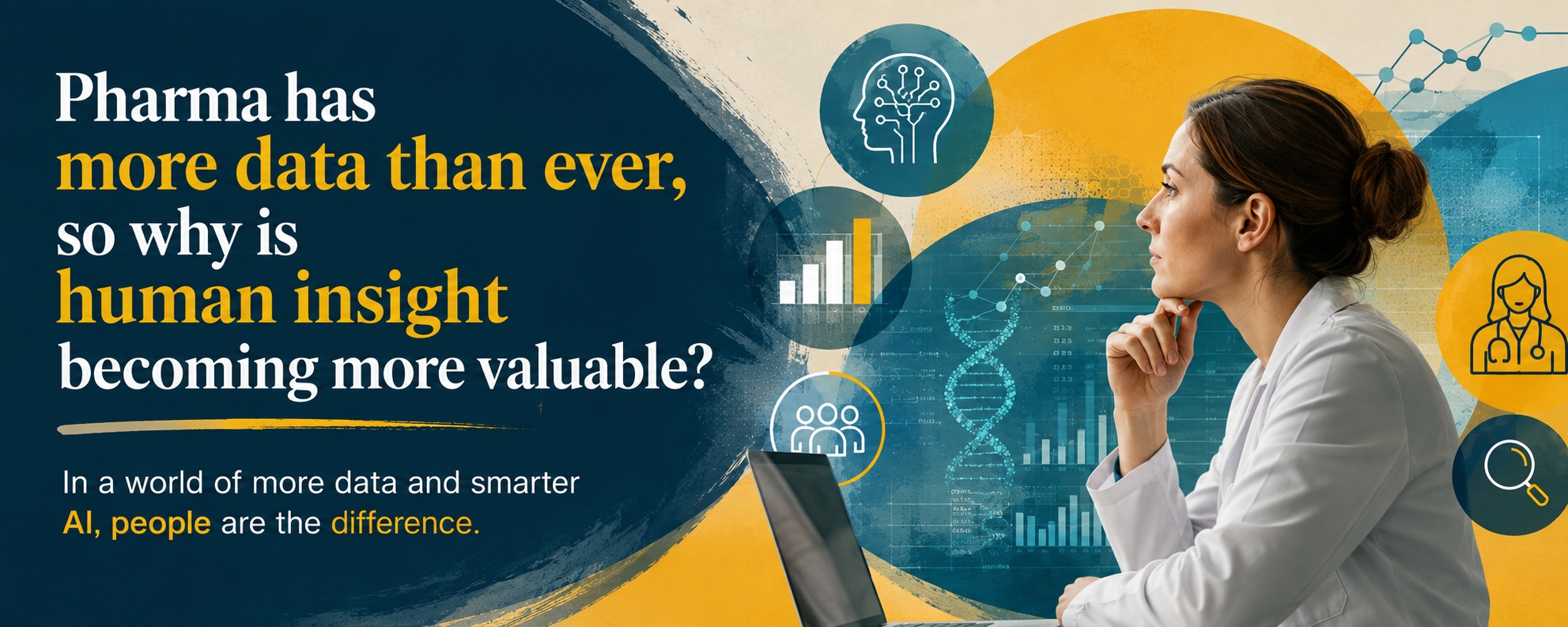
Pharma has more data than ever, so why is human insight becoming more valuable?
Healthcare and pharmaceutical organisations have never had access to so much information. From electronic health records and patient registries to real-world evidence, genomics and AI-powered analytics, the volume of healthcare data continues to grow at an unprecedented rate. In fact, IDC estimates that healthcare is one of the world’s fastest-growing data industries, with healthcare data expected to grow at a compound annual growth rate of 36% annually.
At the same time, AI adoption across life sciences is accelerating rapidly. A 2025 McKinsey survey found that around 70% of organisations are regularly using generative AI in at least one business function, while pharmaceutical companies are increasingly investing in AI for drug discovery, clinical trial design and forecasting.
With so much data available and increasingly sophisticated tools capable of analysing it, it would be easy to assume that the need for human insight professionals is diminishing.
In reality, many organisations are finding the opposite
The challenge facing healthcare businesses today is no longer a lack of information. It’s making sense of what that information means. Data can identify patterns, but it cannot always explain the human behaviours driving them. It can tell us what happened, but not necessarily why.
This is particularly important in healthcare, where decisions are influenced by a complex mix of patient experiences, healthcare professional behaviours, emotional drivers, organisational pressures and unmet needs. A dashboard may show declining treatment adherence, but understanding the barriers patients face requires empathy, context and interpretation. Likewise, AI can surface emerging trends among HCPs, but understanding whether those trends represent genuine changes in behaviour or temporary anomalies often requires human judgement.
The UK Government’s Skills England report highlights this distinction. Rather than viewing AI as a replacement for expert professionals, it characterises the technology as augmenting scientific judgement and reshaping jobs. In other words, AI is becoming a powerful tool, but people remain responsible for interpreting outputs, challenging assumptions and applying critical thinking.
This creates an interesting shift for insights professionals
Historically, much of the value within insights functions came from generating research and gathering evidence. Increasingly, technology can help automate elements of data collection, analysis and reporting. As this happens, the differentiator for talent is moving further upstream.
The professionals creating the greatest impact are often those who can connect multiple sources of evidence, spot contradictions, ask better questions and influence business decisions. They are the people who can translate complexity into clear recommendations and challenge stakeholders when the data doesn’t tell the full story.
This is something we’re hearing regularly across the healthcare insights market. Demand remains strong for individuals who combine technical understanding with commercial thinking, stakeholder management and strategic interpretation. Organisations still need experts who understand patients, healthcare professionals and healthcare systems, even as data becomes more sophisticated.
The paradox is that the more data organisations have access to, the more important human insight becomes. Technology may help uncover answers faster, but understanding people remains at the heart of effective decision-making. As AI continues to evolve, it looks increasingly likely that the future of insights won’t be defined by who can produce the most data, but by who can make the best decisions from it.
If you would be interested in joining our healthcare community to discuss the pharma/healthcare insights industry, we would love to see you in our LinkedIn group!
Contact roshni@elizabethnorman.com for more information.